In a First, an Astronomer May Have Witnessed a Comet Stop Its Spin--Then Reverse Its Rotation
Archival images snapped by the Hubble Space Telescope revealed the unusual event
Sara Hashemi - Daily Correspondent
April 2, 2026 12:56 p.m.
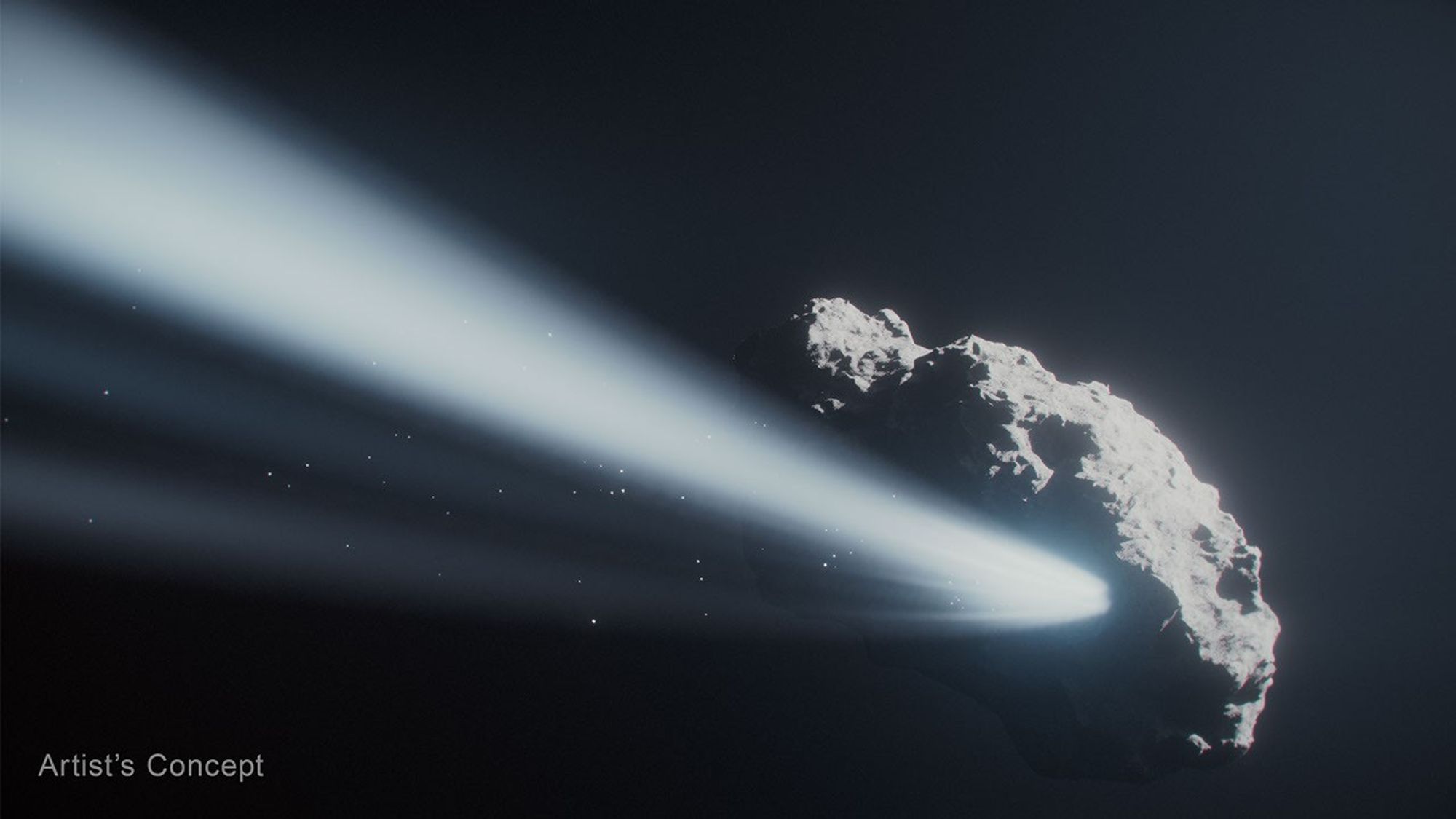
An artist's concept of comet 41P as it approached the sun, turning some of its ice into gaseous jets. NASA / ESA / CSA / Ralf Crawford (STScI)
Comets are unpredictable objects. Scientists struggle to predict the paths and brightnesses of these icy space rocks. Now, an astronomer has caught something especially strange: a comet possibly flipping its rotation.
The observation was described on March 26 in the Astronomical Journal.
Nine years ago, comet 41P/Tuttle-Giacobini-Kresák—41P for short—dramatically slowed its spin. Researchers reported that in early 2017, the comet took about 46 to 60 hours to complete one rotation, more than twice as long as its previous roughly 20-hour spin.
Comets do sometimes change their rotation rates, but usually by mere minutes. “By so many hours and so drastically, that we’ve never seen,” says Dennis Bodewits, an astronomer at Auburn University and a co-author of the older study, to Jonathan O’Callaghan at the New York Times.
It turns out that comet 41P’s rotation got even weirder after that. Recently, David Jewitt, an astronomer at the University of California, Los Angeles, analyzed archival images snapped by the Hubble Space Telescope in December 2017. At that point, the space rock’s spin had sped up again to about 14 hours per rotation, he found.
The simplest explanation for that year’s events? Comet 41P slowed its spin, came to a stop, then began to rotate in the opposite direction.
More:
https://www.smithsonianmag.com/smart-news/in-a-first-an-astronomer-may-have-witnessed-a-comet-stop-its-spin-then-reverse-its-rotation-180988469/

 = new reply since forum marked as read


