Welcome to DU!
The truly grassroots left-of-center political community where regular people, not algorithms, drive the discussions and set the standards.
Join the community:
Create a free account
Support DU (and get rid of ads!):
Become a Star Member
Latest Breaking News
Editorials & Other Articles
General Discussion
The DU Lounge
All Forums
Issue Forums
Culture Forums
Alliance Forums
Region Forums
Support Forums
Help & Search
American History
Related: About this forumOn this day, March 16, 1968, the My Lai massacre occurred.
Last edited Mon Mar 16, 2026, 03:13 PM - Edit history (2)
My Lai Massacre
Mỹ Lai Massacre
Thảm sát Mỹ Lai
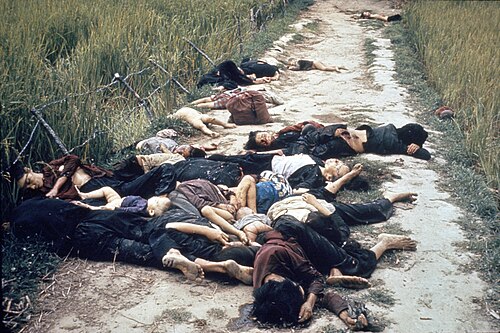
Photo taken by US Army photographer Ronald L. Haeberle on 16 March 1968, in the aftermath of the Mỹ Lai Massacre showing mostly women and children dead on a road
Location Sơn Mỹ (village), Sơn Tịnh District, South Vietnam
Coordinates: 15°10'42"N 108°52'10"E
Date: 16 March 1968
Target: My Lai 4 and My Khe 4 hamlets
Deaths: 347 according to the United States Army (not including My Khe killings), others estimate more than 400 killed and injuries are unknown; the Vietnamese government lists 504 killed in total from both My Lai and My Khe
The Mỹ Lai massacre (/ˌmiːˈlaɪ/; Vietnamese: Thảm sát Mỹ Lai [tʰâːm ʂǎːt mǐˀ lāːj] (listen)) was the mass murder of unarmed South Vietnamese civilians by United States troops in Sơn Tịnh District, South Vietnam, on 16 March 1968 during the Vietnam War. Between 347 and 504 unarmed people were killed by U.S. Army soldiers from Company C, 1st Battalion, 20th Infantry Regiment and Company B, 4th Battalion, 3rd Infantry Regiment, 11th Brigade, 23rd (Americal) Infantry Division. Victims included men, women, children, and infants. Some of the women were gang-raped and their bodies mutilated, and some mutilated and raped children who were as young as 12. Twenty-six soldiers were charged with criminal offenses, but only Lieutenant William Calley Jr., a platoon leader in C Company, was convicted. Found guilty of murdering 22 villagers, he was originally given a life sentence, but served three-and-a-half years under house arrest after President Richard Nixon commuted his sentence.
This war crime, which was later called "the most shocking episode of the Vietnam War", took place in two hamlets of Sơn Mỹ village in Quảng Ngãi Province. These hamlets were marked on the U.S. Army topographic maps as Mỹ Lai and Mỹ Khê.
The U.S. Army slang name for the hamlets and sub-hamlets in that area was Pinkville, and the carnage was initially referred to as the Pinkville Massacre. Later, when the U.S. Army started its investigation, the media changed it to the Massacre at Songmy. Currently, the event is referred to as the Mỹ Lai Massacre in the United States and called the Sơn Mỹ Massacre in Vietnam.
The incident prompted global outrage when it became public knowledge in November 1969. The incident contributed to domestic opposition to the U.S. involvement in the Vietnam War, both because of the scope of killing and cover-up attempts.
Initially, three U.S. servicemen who had tried to halt the massacre and rescue the hiding civilians were shunned, and even denounced as traitors by several U.S. Congressmen, including Mendel Rivers (D–SC), Chairman of the House Armed Services Committee. Thirty years later, these servicemen were recognized and decorated, one posthumously, by the U.S. Army for shielding non-combatants from harm in a war zone.
Mỹ Lai is the largest publicized massacre of civilians by U.S. forces in the 20th century.
{snip}
Operation
{snip}
Helicopter crew intervention
Warrant Officer Hugh Thompson Jr., a helicopter pilot from Company B (Aero-Scouts), 123rd Aviation Battalion, Americal Division, saw dead and wounded civilians as he was flying over the village of Sơn Mỹ, providing close-air support for ground forces. The crew made several attempts to radio for help for the wounded. They landed their helicopter by a ditch, which they noted was full of bodies and in which they could discern movement by survivors. Thompson asked a sergeant he encountered there (David Mitchell of 1st Platoon) if he could help get the people out of the ditch; the sergeant replied that he would "help them out of their misery". Thompson, shocked and confused, then spoke with 2LT Calley, who claimed to be "just following orders". As the helicopter took off, Thompson saw Mitchell firing into the ditch.
{snip}
Aftermath
{snip}
Reporting, cover-up and investigation
{snip}
Six months later, Tom Glen, a 21-year-old soldier of the 11th Light Infantry Brigade, wrote a letter to General Creighton Abrams, the new MACV commander. He described an ongoing and routine brutality against Vietnamese civilians on the part of American forces in Vietnam that he personally witnessed and then concluded,
{snip}
Independent investigative journalist Seymour Hersh, after extensive interviews with Calley, broke the Mỹ Lai story on 12 November 1969, on the Associated Press wire service; on 20 November, Time, Life and Newsweek all covered the story, and CBS televised an interview with Paul Meadlo, a soldier in Calley's unit during the massacre. The Plain Dealer (Cleveland, Ohio) published explicit photographs of dead villagers killed at Mỹ Lai.
{snip}
Mỹ Lai Massacre
Thảm sát Mỹ Lai
Photo taken by US Army photographer Ronald L. Haeberle on 16 March 1968, in the aftermath of the Mỹ Lai Massacre showing mostly women and children dead on a road
Location Sơn Mỹ (village), Sơn Tịnh District, South Vietnam
Coordinates: 15°10'42"N 108°52'10"E
Date: 16 March 1968
Target: My Lai 4 and My Khe 4 hamlets
Deaths: 347 according to the United States Army (not including My Khe killings), others estimate more than 400 killed and injuries are unknown; the Vietnamese government lists 504 killed in total from both My Lai and My Khe
The Mỹ Lai massacre (/ˌmiːˈlaɪ/; Vietnamese: Thảm sát Mỹ Lai [tʰâːm ʂǎːt mǐˀ lāːj] (listen)) was the mass murder of unarmed South Vietnamese civilians by United States troops in Sơn Tịnh District, South Vietnam, on 16 March 1968 during the Vietnam War. Between 347 and 504 unarmed people were killed by U.S. Army soldiers from Company C, 1st Battalion, 20th Infantry Regiment and Company B, 4th Battalion, 3rd Infantry Regiment, 11th Brigade, 23rd (Americal) Infantry Division. Victims included men, women, children, and infants. Some of the women were gang-raped and their bodies mutilated, and some mutilated and raped children who were as young as 12. Twenty-six soldiers were charged with criminal offenses, but only Lieutenant William Calley Jr., a platoon leader in C Company, was convicted. Found guilty of murdering 22 villagers, he was originally given a life sentence, but served three-and-a-half years under house arrest after President Richard Nixon commuted his sentence.
This war crime, which was later called "the most shocking episode of the Vietnam War", took place in two hamlets of Sơn Mỹ village in Quảng Ngãi Province. These hamlets were marked on the U.S. Army topographic maps as Mỹ Lai and Mỹ Khê.
The U.S. Army slang name for the hamlets and sub-hamlets in that area was Pinkville, and the carnage was initially referred to as the Pinkville Massacre. Later, when the U.S. Army started its investigation, the media changed it to the Massacre at Songmy. Currently, the event is referred to as the Mỹ Lai Massacre in the United States and called the Sơn Mỹ Massacre in Vietnam.
The incident prompted global outrage when it became public knowledge in November 1969. The incident contributed to domestic opposition to the U.S. involvement in the Vietnam War, both because of the scope of killing and cover-up attempts.
Initially, three U.S. servicemen who had tried to halt the massacre and rescue the hiding civilians were shunned, and even denounced as traitors by several U.S. Congressmen, including Mendel Rivers (D–SC), Chairman of the House Armed Services Committee. Thirty years later, these servicemen were recognized and decorated, one posthumously, by the U.S. Army for shielding non-combatants from harm in a war zone.
Mỹ Lai is the largest publicized massacre of civilians by U.S. forces in the 20th century.
{snip}
Operation
{snip}
Helicopter crew intervention
Warrant Officer Hugh Thompson Jr., a helicopter pilot from Company B (Aero-Scouts), 123rd Aviation Battalion, Americal Division, saw dead and wounded civilians as he was flying over the village of Sơn Mỹ, providing close-air support for ground forces. The crew made several attempts to radio for help for the wounded. They landed their helicopter by a ditch, which they noted was full of bodies and in which they could discern movement by survivors. Thompson asked a sergeant he encountered there (David Mitchell of 1st Platoon) if he could help get the people out of the ditch; the sergeant replied that he would "help them out of their misery". Thompson, shocked and confused, then spoke with 2LT Calley, who claimed to be "just following orders". As the helicopter took off, Thompson saw Mitchell firing into the ditch.
{snip}
Aftermath
{snip}
Reporting, cover-up and investigation
{snip}
Six months later, Tom Glen, a 21-year-old soldier of the 11th Light Infantry Brigade, wrote a letter to General Creighton Abrams, the new MACV commander. He described an ongoing and routine brutality against Vietnamese civilians on the part of American forces in Vietnam that he personally witnessed and then concluded,
It would indeed be terrible to find it necessary to believe that an American soldier that harbors such racial intolerance and disregard for justice and human feeling is a prototype of all American national character; yet the frequency of such soldiers lends credulity to such beliefs. ... What has been outlined here I have seen not only in my own unit, but also in others we have worked with, and I fear it is universal. If this is indeed the case, it is a problem which cannot be overlooked, but can through a more firm implementation of the codes of MACV (Military Assistance Command Vietnam) and the Geneva Conventions, perhaps be eradicated.
{snip}
Independent investigative journalist Seymour Hersh, after extensive interviews with Calley, broke the Mỹ Lai story on 12 November 1969, on the Associated Press wire service; on 20 November, Time, Life and Newsweek all covered the story, and CBS televised an interview with Paul Meadlo, a soldier in Calley's unit during the massacre. The Plain Dealer (Cleveland, Ohio) published explicit photographs of dead villagers killed at Mỹ Lai.
{snip}
Reposted by Kevin M. Kruse
https://bsky.app/profile/kevinmkruse.bsky.social
John Bull
@garius.bsky.social
It is the anniversary of the My Lai massacre today. I'd say that even more than most years, it's important to remember what happened.
And the role Hugh Thompson, an active serviceman, played in both stopping and publicising it. Despite enormous military, political and public pressure to stay quiet.
John Bull
@garius.bsky.social
· Jul 30, 2024
On 16th March, 1968 Warrant Officer Hugh Thompson Jnr was flying helicopter recon for a US attack on My Lai, an alleged Viet Cong-controlled village in Vietnam.
But as the attack developed below, Thompson realised he was witnessing something something else:
A massacre.
He decided to act. 1/28
a young, brown-haired, clean-shaven american man in a green army uniform. he looks stern.
ALT
3:29 AM · Mar 16, 2026
@garius.bsky.social
It is the anniversary of the My Lai massacre today. I'd say that even more than most years, it's important to remember what happened.
And the role Hugh Thompson, an active serviceman, played in both stopping and publicising it. Despite enormous military, political and public pressure to stay quiet.
John Bull
@garius.bsky.social
· Jul 30, 2024
On 16th March, 1968 Warrant Officer Hugh Thompson Jnr was flying helicopter recon for a US attack on My Lai, an alleged Viet Cong-controlled village in Vietnam.
But as the attack developed below, Thompson realised he was witnessing something something else:
A massacre.
He decided to act. 1/28
a young, brown-haired, clean-shaven american man in a green army uniform. he looks stern.
ALT
3:29 AM · Mar 16, 2026
It is the anniversary of the My Lai massacre today. I'd say that even more than most years, it's important to remember what happened.
— John Bull (@garius.bsky.social) 2026-03-16T07:29:29.451Z
And the role Hugh Thompson, an active serviceman, played in both stopping and publicising it. Despite enormous military, political and public pressure to stay quiet.
John Bull
@garius.bsky.social
On 16th March, 1968 Warrant Officer Hugh Thompson Jnr was flying helicopter recon for a US attack on My Lai, an alleged Viet Cong-controlled village in Vietnam.
But as the attack developed below, Thompson realised he was witnessing something something else:
A massacre.
He decided to act. 1/28
a young, brown-haired, clean-shaven american man in a green army uniform. he looks stern.
ALT
3:50 AM · Jul 30, 2024
@garius.bsky.social
On 16th March, 1968 Warrant Officer Hugh Thompson Jnr was flying helicopter recon for a US attack on My Lai, an alleged Viet Cong-controlled village in Vietnam.
But as the attack developed below, Thompson realised he was witnessing something something else:
A massacre.
He decided to act. 1/28
a young, brown-haired, clean-shaven american man in a green army uniform. he looks stern.
ALT
3:50 AM · Jul 30, 2024
On 16th March, 1968 Warrant Officer Hugh Thompson Jnr was flying helicopter recon for a US attack on My Lai, an alleged Viet Cong-controlled village in Vietnam.
— John Bull (@garius.bsky.social) 2024-07-30T07:50:43.658Z
But as the attack developed below, Thompson realised he was witnessing something something else:
A massacre.
He decided to act. 1/28
Hugh Thompson Jr.

Thompson in 1966
Birth name: Hugh Clowers Thompson Jr.
Born: April 15, 1943; Atlanta, Georgia, U.S.
Died: January 6, 2006 (aged 62); Pineville, Louisiana, U.S.
Conflicts:
Vietnam War: Tet Counteroffensive, Mỹ Lai massacre
Awards: Soldier's Medal, Distinguished Flying Cross, Air Medal
Hugh Clowers Thompson Jr. (April 15, 1943 – January 6, 2006) was a United States Army officer, serving as a warrant officer in the 123rd Aviation Battalion of the 23rd Infantry Division. He is credited with ending the Mỹ Lai massacre of the South Vietnamese village known as Sơn Mỹ on March 16, 1968, alongside Glenn Andreotta and Lawrence Colburn.
During the massacre, Thompson and his Hiller OH-23 Raven crew, Andreotta and Colburn, stopped many killings by threatening and blocking American officers and enlisted soldiers of Company C, 1st Battalion, 20th Infantry Regiment, 11th Brigade, 23rd Infantry Division. Additionally, Thompson and his crew saved a number of Vietnamese civilians by personally escorting them away from advancing United States Army ground units and assuring their evacuation by air. Thompson reported the atrocities by radio several times while at Sơn Mỹ. Although these reports reached Task Force Barker operational headquarters, nothing was done to stop the massacre. After evacuating a child to a Quảng Ngãi hospital, Thompson angrily reported to his superiors at Task Force Barker headquarters that a massacre was occurring at Sơn Mỹ. Immediately following Thompson's report, Lieutenant Colonel Frank A. Barker ordered all ground units in Sơn Mỹ to cease search and destroy operations in the village.
In 1970, Thompson testified against those responsible for the Mỹ Lai massacre. Twenty-six officers and enlisted soldiers, including William Calley and Ernest Medina, were charged with criminal offenses; many were either acquitted or pardoned, notably excepting Calley, who was convicted and served a commuted sentence of three-and-a-half years under house arrest. Thompson was condemned and ostracized by many individuals in the United States military and government, as well as the public, for his role in the investigations and trials concerning the Mỹ Lai massacre. As a result of what he experienced, Thompson experienced post-traumatic stress disorder, alcoholism, divorce, and severe nightmare disorder. Despite the adversity he faced, he remained in the Army until November 1, 1983, then continued to make a living as a helicopter pilot in the Southeastern United States.
In 1998, 30 years after the massacre, Thompson and the two other members of his crew, Andreotta and Colburn, were awarded the Soldier's Medal (Andreotta posthumously), the United States Army's highest award for bravery not involving direct contact with the enemy. Thompson and Colburn returned to Sơn Mỹ to meet with survivors of the massacre at the Sơn Mỹ Memorial in 1998. In 1999, Thompson and Colburn received the Peace Abbey Courage of Conscience Award.
{snip}
Thompson in 1966
Birth name: Hugh Clowers Thompson Jr.
Born: April 15, 1943; Atlanta, Georgia, U.S.
Died: January 6, 2006 (aged 62); Pineville, Louisiana, U.S.
Conflicts:
Vietnam War: Tet Counteroffensive, Mỹ Lai massacre
Awards: Soldier's Medal, Distinguished Flying Cross, Air Medal
Hugh Clowers Thompson Jr. (April 15, 1943 – January 6, 2006) was a United States Army officer, serving as a warrant officer in the 123rd Aviation Battalion of the 23rd Infantry Division. He is credited with ending the Mỹ Lai massacre of the South Vietnamese village known as Sơn Mỹ on March 16, 1968, alongside Glenn Andreotta and Lawrence Colburn.
During the massacre, Thompson and his Hiller OH-23 Raven crew, Andreotta and Colburn, stopped many killings by threatening and blocking American officers and enlisted soldiers of Company C, 1st Battalion, 20th Infantry Regiment, 11th Brigade, 23rd Infantry Division. Additionally, Thompson and his crew saved a number of Vietnamese civilians by personally escorting them away from advancing United States Army ground units and assuring their evacuation by air. Thompson reported the atrocities by radio several times while at Sơn Mỹ. Although these reports reached Task Force Barker operational headquarters, nothing was done to stop the massacre. After evacuating a child to a Quảng Ngãi hospital, Thompson angrily reported to his superiors at Task Force Barker headquarters that a massacre was occurring at Sơn Mỹ. Immediately following Thompson's report, Lieutenant Colonel Frank A. Barker ordered all ground units in Sơn Mỹ to cease search and destroy operations in the village.
In 1970, Thompson testified against those responsible for the Mỹ Lai massacre. Twenty-six officers and enlisted soldiers, including William Calley and Ernest Medina, were charged with criminal offenses; many were either acquitted or pardoned, notably excepting Calley, who was convicted and served a commuted sentence of three-and-a-half years under house arrest. Thompson was condemned and ostracized by many individuals in the United States military and government, as well as the public, for his role in the investigations and trials concerning the Mỹ Lai massacre. As a result of what he experienced, Thompson experienced post-traumatic stress disorder, alcoholism, divorce, and severe nightmare disorder. Despite the adversity he faced, he remained in the Army until November 1, 1983, then continued to make a living as a helicopter pilot in the Southeastern United States.
In 1998, 30 years after the massacre, Thompson and the two other members of his crew, Andreotta and Colburn, were awarded the Soldier's Medal (Andreotta posthumously), the United States Army's highest award for bravery not involving direct contact with the enemy. Thompson and Colburn returned to Sơn Mỹ to meet with survivors of the massacre at the Sơn Mỹ Memorial in 1998. In 1999, Thompson and Colburn received the Peace Abbey Courage of Conscience Award.
{snip}
Glenn Andreotta

Glenn Andreotta in 1966
Born: October 30, 1947; Newton, New Jersey, U.S.
Died: April 8, 1968 (aged 20); near Quang Ngai City, Quảng Ngãi Province, South Vietnam
Allegiance United States of America
Branch United States Army
Service years: 1966 - 1968
Rank: Specialist 4; Unit 161st Assault Helicopter Company
Conflicts: Vietnam War †
Awards: Bronze Star, Soldier's Medal
Glenn Urban Andreotta (October 30, 1947 – April 8, 1968) was an American helicopter crew chief in the Vietnam War noted for being one of three who intervened in the Mỹ Lai massacre, in which 504 unarmed children, women and men were murdered.
{snip}
After the massacre
Andreotta was killed shortly after the events at My Lai while serving in B Company {the "Warlords"} of the 123rd Aviation Battalion of the Americal Division (the 161st Assault Helicopter Company had been reorganized into the 123rd Battalion in January 1968). On April 8 he was serving as the door gunner aboard OH-23 helicopter 62-03813, along with crew chief Specialist Five Charles M. Dutton and pilot First Lieutenant Barry Lloyd.
Viet Cong activity was reported 10 kilometers (6.2 miles) southwest of Quảng Ngãi, and their scout helicopter was ordered to accompany two gunships to that location and flush out and destroy the enemy. Andreotta was killed outright by small-arms fire from the ground, a single shot to his head. Then a North Vietnamese 12.7 mm anti-aircraft machine gun began firing on the scout, destroying both the swashplate and control panel. Dutton was covered in burning avgas when the craft finally hit the ground, and a North Vietnamese soldier ran towards the wreckage and shot him, before retreating— leaving a wounded Lloyd lying in shock where he had been thrown from the impact. He was rescued by Warrant Officer One Michael Banek's UH-1 Huey and taken to Chu Lai. The helicopter was officially declared "Destroyed by Fire" by the US Military on April 11, although both Andreotta's and Dutton's bodies were recovered.
{snip}
Glenn Andreotta in 1966
Born: October 30, 1947; Newton, New Jersey, U.S.
Died: April 8, 1968 (aged 20); near Quang Ngai City, Quảng Ngãi Province, South Vietnam
Allegiance United States of America
Branch United States Army
Service years: 1966 - 1968
Rank: Specialist 4; Unit 161st Assault Helicopter Company
Conflicts: Vietnam War †
Awards: Bronze Star, Soldier's Medal
Glenn Urban Andreotta (October 30, 1947 – April 8, 1968) was an American helicopter crew chief in the Vietnam War noted for being one of three who intervened in the Mỹ Lai massacre, in which 504 unarmed children, women and men were murdered.
{snip}
After the massacre
Andreotta was killed shortly after the events at My Lai while serving in B Company {the "Warlords"} of the 123rd Aviation Battalion of the Americal Division (the 161st Assault Helicopter Company had been reorganized into the 123rd Battalion in January 1968). On April 8 he was serving as the door gunner aboard OH-23 helicopter 62-03813, along with crew chief Specialist Five Charles M. Dutton and pilot First Lieutenant Barry Lloyd.
Viet Cong activity was reported 10 kilometers (6.2 miles) southwest of Quảng Ngãi, and their scout helicopter was ordered to accompany two gunships to that location and flush out and destroy the enemy. Andreotta was killed outright by small-arms fire from the ground, a single shot to his head. Then a North Vietnamese 12.7 mm anti-aircraft machine gun began firing on the scout, destroying both the swashplate and control panel. Dutton was covered in burning avgas when the craft finally hit the ground, and a North Vietnamese soldier ran towards the wreckage and shot him, before retreating— leaving a wounded Lloyd lying in shock where he had been thrown from the impact. He was rescued by Warrant Officer One Michael Banek's UH-1 Huey and taken to Chu Lai. The helicopter was officially declared "Destroyed by Fire" by the US Military on April 11, although both Andreotta's and Dutton's bodies were recovered.
{snip}
Lawrence Colburn

Colburn in 1966
Birth name: Lawrence Manley Colburn
Born: July 6, 1949; Coulee Dam, Washington, U.S.
Died: December 13, 2016 (aged 67);
Canton, Georgia, U.S.
Rank: Specialist Four
Conflicts: Vietnam War
Awards: Bronze Star, Soldier's Medal
Lawrence Manley Colburn (July 6, 1949 – December 13, 2016) was a United States Army veteran who, while serving as a helicopter gunner in the Vietnam War, intervened in the March 16, 1968 Mỹ Lai massacre.
{snip}
Colburn in 1966
Birth name: Lawrence Manley Colburn
Born: July 6, 1949; Coulee Dam, Washington, U.S.
Died: December 13, 2016 (aged 67);
Canton, Georgia, U.S.
Rank: Specialist Four
Conflicts: Vietnam War
Awards: Bronze Star, Soldier's Medal
Lawrence Manley Colburn (July 6, 1949 – December 13, 2016) was a United States Army veteran who, while serving as a helicopter gunner in the Vietnam War, intervened in the March 16, 1968 Mỹ Lai massacre.
{snip}
Wed Mar 19, 2025: On March 16, 1968, the My Lai massacre occurred.
Tue Nov 12, 2024: On this day, November 12, 1969, Seymour Hersh broke the My Lai massacre story
Sat Mar 16, 2024: On this day, March 16, 1968, the My Lai massacre occurred.
Sun Nov 12, 2023: On this day, November 12, 1969, Seymour Hersh broke the My Lai massacre story
Fri Mar 17, 2023: On March 16, 1968, Warrant Officer Hugh Thompson Jr was flying helicopter reconnaissance at My Lai.
Sat Nov 12, 2022: On this day, November 12, 1969, Seymour Hersh broke the My Lai massacre story
Tue Nov 12, 2019: Fifty years ago on this day, November 12, 1969, Seymour Hersh broke the My Lai massacre story
Hat tips, Wikipedia and Dennis Donovan. There's too much to copy. Go look at DD's post.
Sat Mar 16, 2019: 51 Years Ago Today; My Lai Massacre (WARNING: Graphic Images)
2 replies
 = new reply since forum marked as read
Highlight:
NoneDon't highlight anything
5 newestHighlight 5 most recent replies
= new reply since forum marked as read
Highlight:
NoneDon't highlight anything
5 newestHighlight 5 most recent replies
= new reply since forum marked as read
Highlight:
NoneDon't highlight anything
5 newestHighlight 5 most recent replies
On this day, March 16, 1968, the My Lai massacre occurred. (Original Post)
mahatmakanejeeves
16 hrs ago
OP

c-rational
(3,192 posts)1. K&R.

spike jones
(2,017 posts)2. Kill Anything That Moves