Environment & Energy
Related: About this forum
Atoms For Justice: Dying of Thirst: Dispatches From the Energy Poor in Africa by Princy Mthonbeni.
Princy Mthonbeni is a pronuclear activist in Africa; I have followed her for a number of years; she is an impressive woman exuding intelligence and decency.
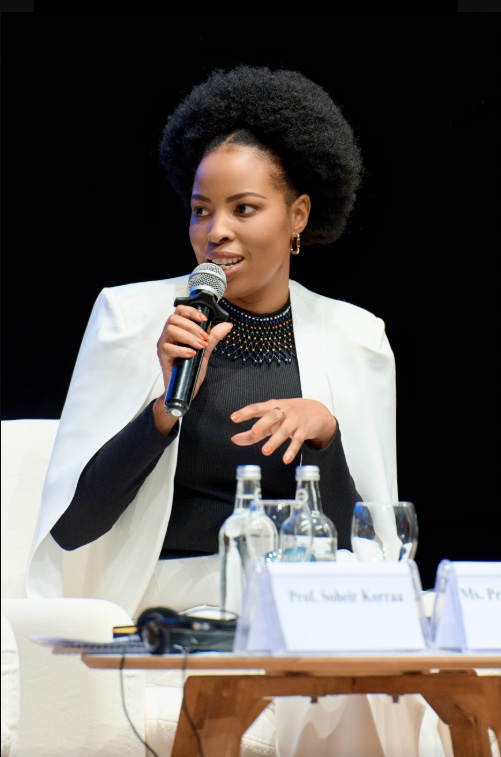
She has recently written a rather long eloquent, thoughtful, piece on poverty in Africa, energy poverty, and injustice and why small intermittent energy systems (which I read as so called "renewable energy) sometimes funded in a miserly self-congratulatory approach by the West represents a form of contempt for Africa.
The full article is here:
The Dying of Thirst
Subtitle:
It's worth a full read, but these excerpts struck me, as it is consistent with some long held views on parochialism in the horrible treatment by the rest of the world of Africans and Africa itself:
The children I saw waiting for water in eNanda do not need a philosophy of less. They need working systems. They need pipes, pumps, treatment plants, electricity, roads, clinics, schools, industry, and governments capable of maintaining all of it. They need abundance disciplined by responsibility, not scarcity decorated with moral language.
What troubles me is that many of the people most confident in this philosophy of less grew up inside abundance they did not have to notice. They grew up with lights that came on, schools that functioned, hospitals that had power, taps that ran, refrigerators that kept food safe, roads that could carry ambulances, and states wealthy enough to make infrastructure feel invisible.
Some of them come from countries whose clean electricity systems were built not by smallness, but by scale: by hydroelectric dams, nuclear power stations, strong grids, public institutions, engineering capacity, and generations of investment.11 They inherited the benefits of energy abundance and then learned to speak about restraint as though restraint were the highest moral achievement.
But restraint means something different when you begin from abundance than when you begin from deprivation. A wealthy society can romanticise using less because it already has more than enough. A poor community cannot romanticise less when less means darkness, unsafe water, smoke in the lungs, food without refrigeration, clinics without reliable electricity, and children walking before sunrise...
...The same pattern appears in development finance. For many years, the international institutions that shaped energy investment in poorer countries made renewable projects much easier to support than nuclear projects. Small solar, mini-grid, and distributed renewable programmes could be praised as climate solutions for Africa, while nuclear power was treated as too difficult, too expensive, too risky, or simply left outside the conversation.12
But for a country like South Africa, that exclusion makes no sense. We already operate Koeberg, the only nuclear power station on the African continent.13 We already have nuclear skills, nuclear institutions, nuclear regulators, nuclear workers, and coastal sites where future nuclear plants could produce electricity and support desalination.14 If international institutions are serious about climate, water, and development, they should not decide in advance that Africa’s clean energy future must be small, intermittent, and dependent. They should ask what scale of energy is required for Africans to live with dignity.
It is easier to romanticise low-energy living when you have never carried water before sunrise, cooked with imbawula or paraffin, studied by candlelight, or watched women spend hours each day securing the most basic necessities for survival.
For many Africans, the debate is not about choosing between development and dignity.
Development is dignity...
The bold, italics and underlining are all mine.
In recent times, I have been commenting in this space on a book I've been reading slowly, along with a number of others, this one:
The Elements of Power
Subtitle:
By Nicolas Niarchos
This is a book about the tragedy of energy related mining in Africa, and the suffering it involves. I have been hearing from the more smug battery worshipping types here, consistent with their contemptuous myopia, that the batteries that their hero, the asshole Elon Musk, makes no longer use lithium NMC chemistry, and so the cobalt slaves who worked in Africa for the rise of Tesla for pittances or nothing at all, often digging ores with no tools other than their bare hands, can now be freed, Elon's junk now having been switched to lithium iron phosphate. I note, with some disgust, that the copper mining slaves in Katanga haven't "lost" their "jobs." The unsustainable material (not to mention land) demands to generate, link, and store so called "renewable energy" still depends heavily on the exploitation of Africa, a major source of minerals. It's not like, either, that the lithium NMC battery chemistry has disappeared either just because Elon wants to market his cars using marginally worse performing batteries.
I could ask to be spared the bullshit, but my request will not be honored; I've been here long enough to know that.
We owe Africa decency. I certainly thank Princy Mthonbeni for her efforts on behalf of the environment, and in a more subtle way, humanity. In asking for decency for Africans she is asking us to rise out our obliviousness to our own lack of decency in the first world; she calls for us to climb out of the moral pit of the mindless pit consumption in which we in the wealthy world blithely live, to seek, to rise to, for our own moral betterment, as in the Lincolnian locution, "the better angels of our nature."
I invite you to be uplifted by awareness, and read this thoughtful piece.
 = new reply since forum marked as read
Highlight:
NoneDon't highlight anything
5 newestHighlight 5 most recent replies
= new reply since forum marked as read
Highlight:
NoneDon't highlight anything
5 newestHighlight 5 most recent replies

DemocracyForever
(425 posts)but nuclear power is not Africa's savior. Nuclear power is much too expensive and toxic nuclear waste presents too great of a risk. There are far less costly and less toxic forms of renewable energy that are the far better option. This is what needs to be fully funded to help Africa transition away from the poisonous fossil fuels.