Environment & Energy
Related: About this forumQuantifying Carbon Leakage from Renewable Shortfalls in China's Power System under Future Scenarios
Last edited Sat Jun 27, 2026, 11:00 PM - Edit history (1)
The paper I'll discuss in this post is this one: Quantifying Carbon Leakage from Renewable Shortfalls in China’s Power System under Future Scenarios Linze Hou, Jianxun Yang, Miaomiao Liu, Wen Fang, Zongwei Ma, and Jun Bi Environmental Science & Technology 2026 60 (20), 14456-14466.
This paper, for the record, involves some credulity inasmuch as it is involved with soothsaying. That said, it focuses on an important point, the point being that so called "renewable energy" is dependent on access to fossil fuels.
There are people around here, in many cases the same people who think that Germany is a so called "renewable energy" paradise, since there are zero fans of so called "renewable energy" who give a rat's ass about fossil fuels - their interest is in attacking the only sustainable form of primary energy there is, nuclear energy - who wish to represent China as some kind of "renewable energy" paradise as well.
It is no such thing.
We see lots of weakly disguised fossil fuel greenwashing ads here at DU and elsewhere, showing vast areas of wilderness rendered into industrial parks for so called "renewable energy" in China, coupled with claims that this unsustainable garbage is used to generate "green hydrogen."
This is, to put it bluntly, a bald faced lie. Electricity generation in China is some of the dirtiest on Earth and thus any electrolytic hydrogen generation in China is dirtier than coal, since the thermal generation of electricity destroys exergy.
In reality, China has over 1000 coal plants, more than the next 20 coal powered nations combined and well over 150 under construction and close to 250 under preconstruction planning. In China, the world's largest producer of hydrogen which it uses for the critical task of fertilizer synthesis using Haber-Bosch ammonia plants, hydrogen is overwhelmingly made by the steam reformation of coal.
According to the Electricity Map China has a 12 month carbon intensity of 483 grams CO2/kWh with coal combustion representing more than 55% of its electricity generation, even worse than that coal dependent hellhole Germany, with a 12 month carbon intensity of 342 grams CO2/kWh compared to nuclear powered France's 12 month carbon intensity of 32 grams CO2/kWh. In "percent talk" electricity's carbon intensity is China is 1,509% higher than that of France, and in Germany 1,069% higher than that of France.
China is also the world's largest producer of unsustainable land and material intensive so called "renewable energy," but since they are a highly industrialized nation, they understand the importance of reliability. Coal is a filthy fuel, but it is something that so called "renewable energy" is not, reliable. The only devices for the generation of electricity that is more reliable than coal are nuclear plants. China leads the world in nuclear power plant construction, and will surpass the United States as the world's largest producer of nuclear power shortly, with 61 nuclear plants operating and 39 under construction.
Nuclear energy is the only form of energy that is a clean, reliable, and sustainable alternative to coal. So called "renewable energy" is not reliable, nor is it, in my opinion, even remotely clean and sustainable, and thus it is not an alternative to coal, no matter how much bullshit is handed out claiming the opposite. So called "renewable energy" depends on access to dangerous fossil fuels.
China has announced that it has a capacity to build 50 nuclear power plants at a time, which is obviously not fast enough, but is better than every other nation on Earth. If their capacity for building nuclear plants continues to grow, to say well over 100 at a time, this is the only option that will address its growing dependence on coal. Obviously to stop building coal plants, China would need to have a capacity for simultaneous nuclear plant construction amounting to 50 + 150 = 200 at a time, if one can add and subtract, something with which I suspect antinukes and "I'm not an antinuke" antinukes apparently have a problem. Since China has displaced the collapsing United States - a nation falling to the power of extreme ignorance - as the world leader in science and engineering, it seems "possible" which is not the same world as "likely".
To shut all of its 1,207 coal plants within 10 years, while not building any more coal plants, China would need to have a capacity to build roughly 300 nuclear plants simultaneously. At that point however, with over 1500 nuclear power plants, electricity would be as clean as that of France, which pretty much has the cleanest electricity in the world. Fifteen hundred nuclear plants is more than 3 times larger than the current world inventory of operable nuclear plants, 438, with another 80 such plants under construction worldwide.
This would not be easy for China, or any nation, to do. In another context I recently quoted my favorite Democrat ever, Eleanor Roosevelt, somewhat out of context, since she was addressing a topic her husband famously also did, fear, and I'm spinning the statement to address a subtext of fear, which is hopelessness leading to a lack of effort. Quoth Eleanor:
To save the world, we must do the thing we think we cannot do, build thousands of nuclear plants rapidly. In this, China, a scientific, manufacturing, and engineering powerhouse, can serve humanity while saving itself. (China also leads the world in deaths from air pollution, quite possibly, although I'm guessing, on a per capita basis.)
A point:
The paper cited at the beginning of this post mentions the word "nuclear" zero times.
It assumes that China will rely on so called "renewable energy" and thus begins the text with a nonsense statement, which I will put in bold:
So called "renewable energy" which has soaked up close to 5.7 trillion dollars in the last ten years has had no effect whatsoever in reducing the use of dangerous fossil fuels, which are being consumed at the highest level ever observed. (Free Registration is required to access the data in the link just provided.)
"I'm not an antinuke" antinukes around here seem to like graphics to support their rhetorical nonsense, which often involves soothsaying (as this paper does), so here's a graphic, not based on soothsaying but rather on "data," from the IEA about world sources of energy:
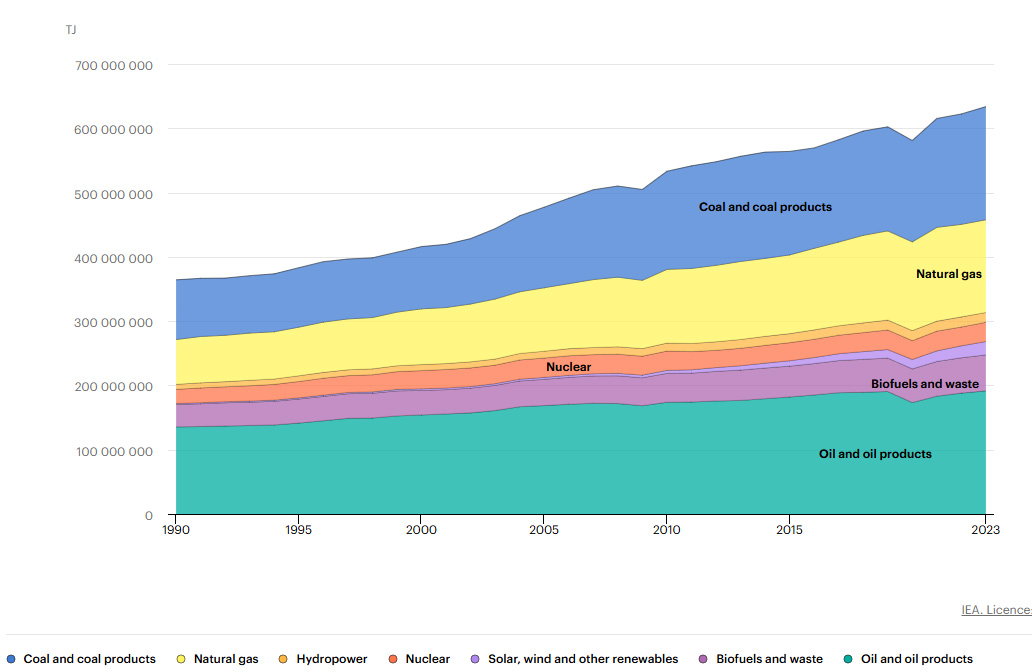
Total energy supply (TES) by source, World, 1990-2023 (Accessed 6/27/2026)
It should be obvious that despite the tremendous and frankly, wasteful, expenditure on solar and wind energy, they remain trivial, especially when compared to dangerous fossil fuels about which antinukes and "I'm not an antinuke" antinukes couldn't care less.
After the appalling and completely ridiculous opening sentence of the paper under discussion, it becomes more realistic.
The weather dependence of both supply and demand is a key driver of intrasystem carbon leakage. (7) These imbalances often translate into renewable shortfalls, which in most countries are still predominantly compensated by thermal power, thereby linking variability directly to additional fossil emissions. On the supply side, VRE generation is highly sensitive to meteorological conditions such as solar irradiance and wind speed, leading to significant fluctuations across daily time scales and spatial regions. For example, over the past two decades, the Middle East, North Africa, the Great Lakes region, the equatorial belt of Asia, and southwestern Australia have experienced declines in photovoltaic output. (8,27) It is projected that future climate change might reduce wind power potential across 30° S–30° N by approximately 5–10%. (9) On the demand side, electricity consumption displays strong seasonality and responds directly to temperature extremes, reflecting heating and cooling needs. (10) These joint dynamics of supply and demand can yield persistent mismatches. (11)
In this excerpt I have bolded a statement that is obvious, while including something of which I have been unaware, that from reference 9. Reference 9 is from the Nature Springer family of journals. This is it:
(Although I have not yet read reference 9 yet, having just downloaded it, from the title I infer the following: Even though wind industry is observationally demonstrated to be useless at addressing climate collapse, throwing more money at it will even be less effective to address the task than it has already established itself as being as the failure to address the climate collapse proceeds).
A note:
I read a lot of scientific papers by the way, a larger and larger number of them coming from Chinese authors in and out of China. Many of the papers have obviously been translated from Chinese into English, and one can see certain signatures of translation, often in the lack of use of English pluralization. By contrast with some of the papers with Chinese authors that I read, the English in this paper is excellent. I mention this since I would quibble to the word they chose define, "leakage." It's not "leakage." It's dependence. So called "renewable energy" depends on the use of and access to fossil fuels. Anyone who opposes all use of fossil fuels, as I do, cannot therefore support so called "renewable energy." Wind turbines and solar cells do not leak fossil fuels after they are manufactured and installed using fossil fuel energy, generally as sources of heat, but also including transportation, installation, etc.
Anyway...
A graphic from the paper outlining the framework of the investigation:
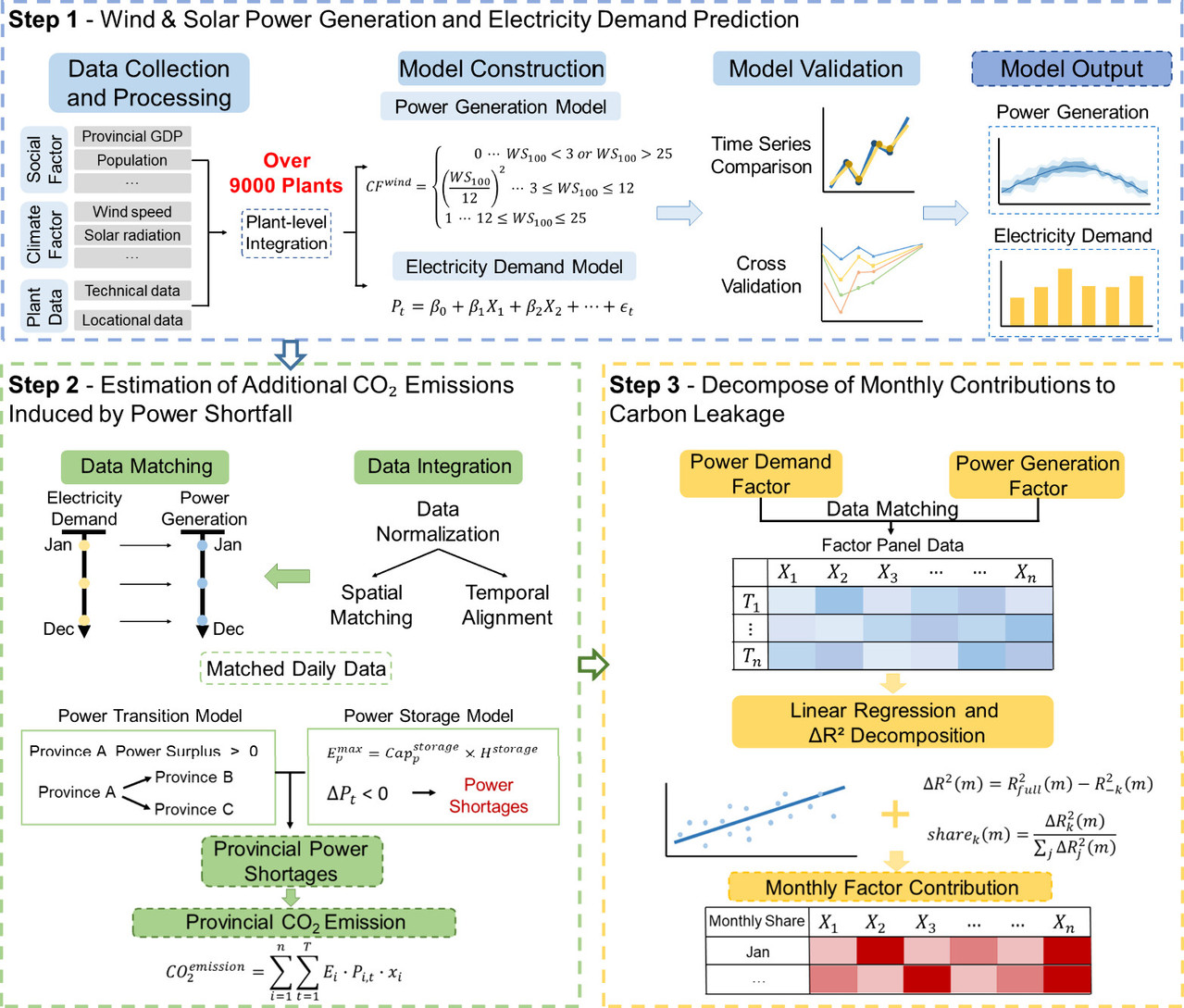
The caption:
Some related text:
We integrate three primary data categories, namely, renewable energy facility data, climate data, and socioeconomic data. We compiled data for over 9700 large-scale wind and solar photovoltaic installations across 30 Chinese provinces with wind and solar plants accounting for 61 and 39%, respectively. For each plant, we collected geographic coordinates, installed capacity, generation technology, operational status, and grid connection attributes from the China Renewable Energy Spatial Data set and Global Energy Monitor’s Global Solar and Wind Trackers. (20,20) These sources cover 95% of China’s total installed wind and solar capacity as of 2020.
An additional figure:
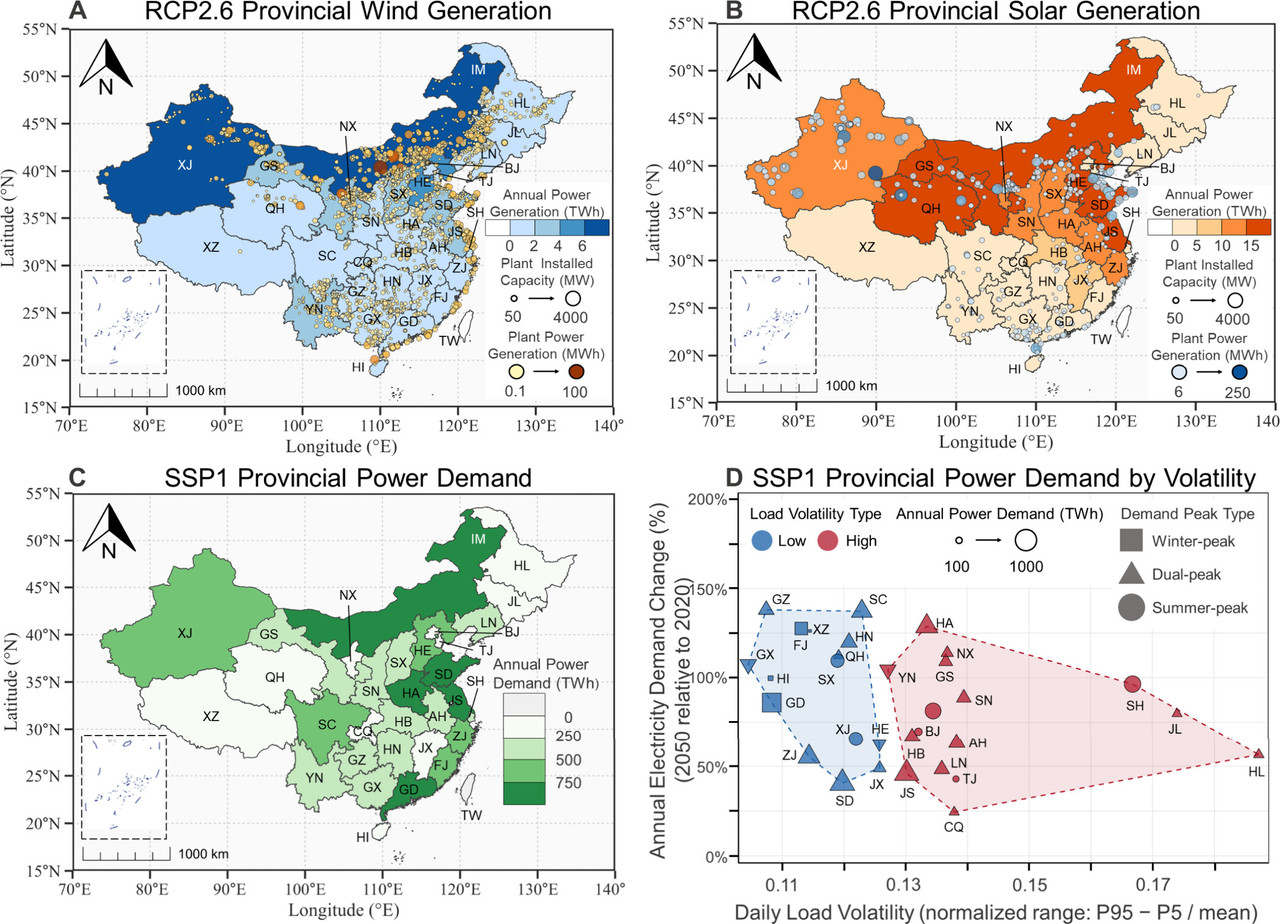
The caption:
The authors offer some equations, replete with empirical constants (too many in my view) for the capacity factors of wind and solar installations, which I have placed in graphic objects to avoid the limitations of the DU editor which lacks an equation function:
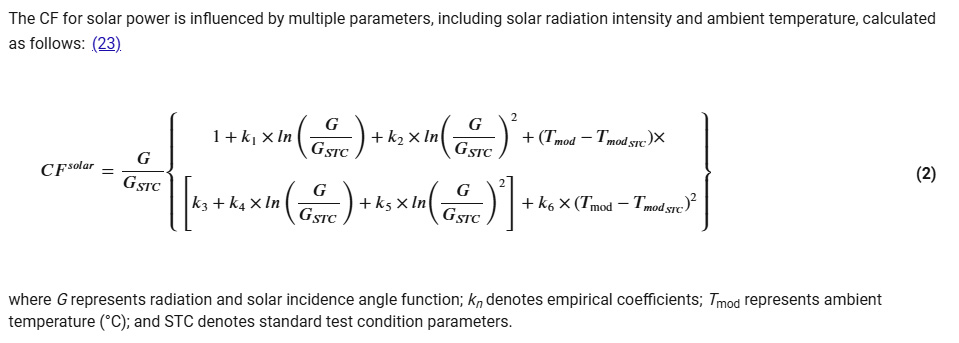
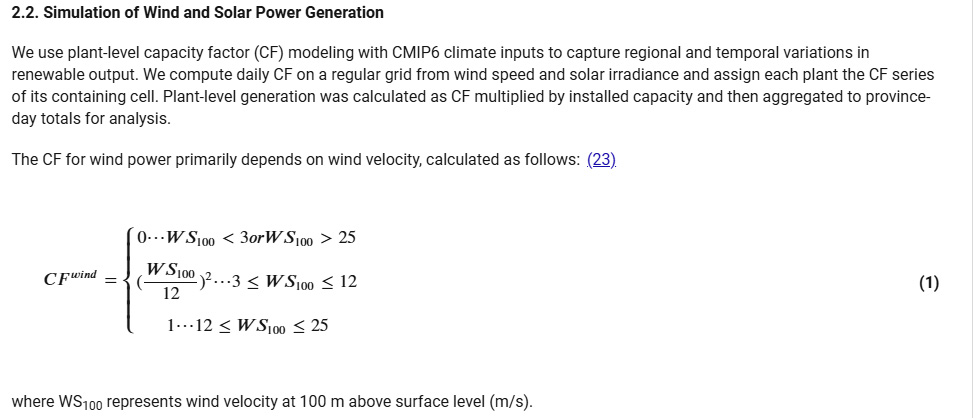
Addition text immediately after these equations:
An additional figure, outlining results claimed by the authors:
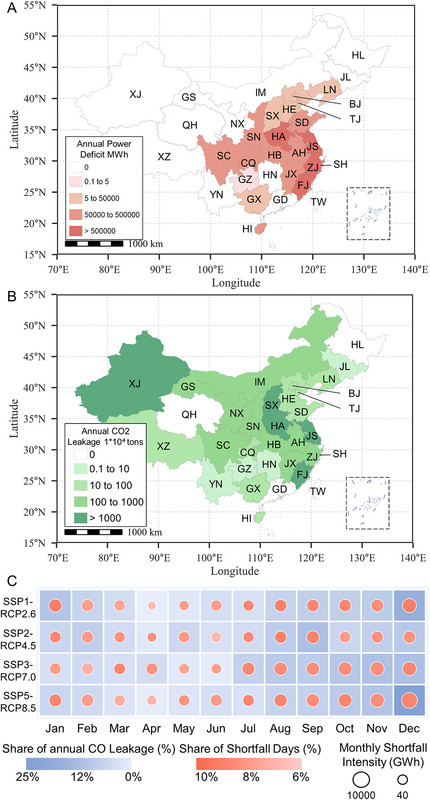
The caption:
Contributors to the need to combust fossil fuels dumping the waste into the planetary atmosphere to address shortages from the lack of reliability of so called "renewable energy."
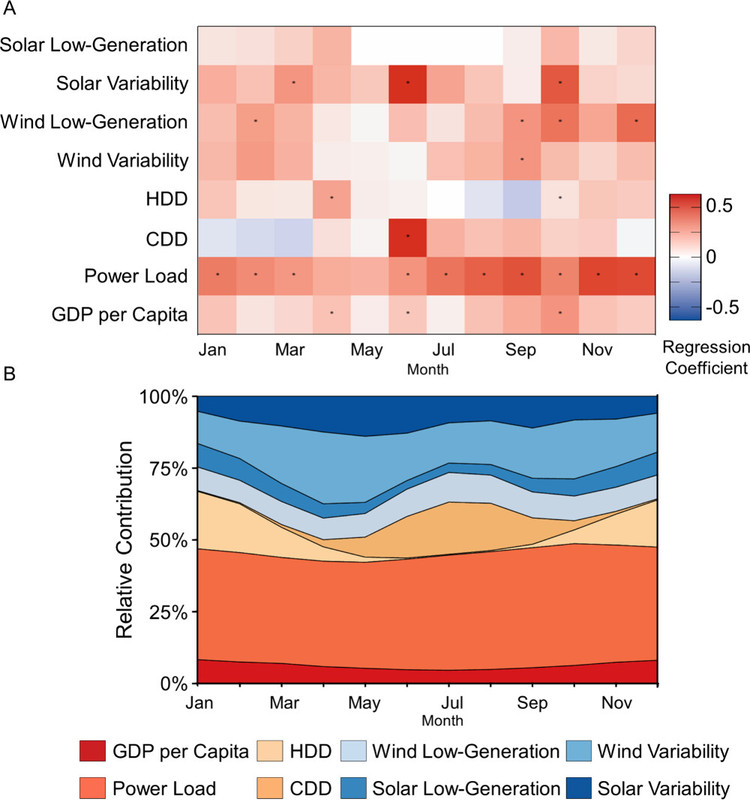
The caption:
HDD is "heating degree days" and CDD is "cooling degree days."
The authors some policy suggestions in the text, none of which speak to me as acceptable, since they ignore the obvious policy improvement of doing away with unreliable and unsustainable so called "renewable energy" in favor of sustainable, reliable, and clean nuclear energy.
Doing the policy improvement that I suggest, of course is not simple nor will it be easy. No nation has demonstrated the ability to be building hundreds of nuclear plants per year, although historically the United States and France, in far more primitive times, demonstrated the ability to have scores of plants under construction simultaneously. China has already exceeded nuclear power plant simultaneous plant construction records set in the 20th century by the United States and France. They must and should do better if they are to do away with coal.
As for reaching the scale of hundreds of plants under simultaneous construction all over the planet, I again appeal to Ms. Roosevelt:
I trust you're having a pleasant weekend.
 = new reply since forum marked as read
Highlight:
NoneDon't highlight anything
5 newestHighlight 5 most recent replies
= new reply since forum marked as read
Highlight:
NoneDon't highlight anything
5 newestHighlight 5 most recent replies
littlemissmartypants
(35,660 posts)
thought crime
(1,839 posts)In the actually existing world we really live in, renewable energy is rapidly developing to provide an obtainable transition to sustainable clean energy.
Nuclear plant buildout is slow and extremely expensive, and we don’t have the ability to safely manage the operation or the generated nuclear waste from thousands of additional nuclear plants. But we don’t need so many nuclear plants, because we are rapidly building many thousands of renewable plants along with improved electric grids to provide clean, reliable energy.
Also, you have it exactly backwards: Most fans of renewable energy do care very much about reducing use of fossil fuels, but don’t think much about nuclear energy at all because it can only provide a limited amount of energy in a safe and manageable way and doesn’t easily scale up like solar and wind energy. In fact, the nuclear industry would likely collapse if it wasn't heavily subsidized by governments that support it as an adjunct to nuclear weapons development.
Eleanor Roosevelt would understand all this. She would doubtless be an ardent supporter of renewable energy and would encourage nuclear bros to give up their dismal dystopian dreams.

NNadir
(38,908 posts)Last edited Fri Jul 3, 2026, 07:27 PM - Edit history (3)
Antinuke knowledge of history may be as poor as that of their knowledge of science and engineering, so to be clear, Franklin Roosevelt was the husband of Eleanor Roosevelt. Although their marriage was described by their daughter Anna as an "armed truce," their political and intellectual partnership was extremely strong, and a key element in the rise of American power to preeminence in the mid-20th century.
The first nuclear reactor was built by the scientist who may have been the greatest, since Isaac Newton, at bridging experimental science and theoretical science, Enrico Fermi.
The very first reactor for carrying out a sustained, controlled nuclear fission reactions in metallic uranium was built, under a squash court at the University of Chicago, and went critical in December 2, 1942.
This event took place three years and one month and 21 days after Alexander Sachs, on October 11, 1939, President Roosevelt's friend and informal advisor, brought the famous (Szilard)-Einstein letter, dated August 9, 1939, to the President, returning the next day to the President to discuss it with President, talking about the effects on history of Napoleon's failure to take Robert Fulton's suggestion of building steam powered ships seriously.
Roosevelt assigned to project to see if there was merit to the Einstein letter of concern to Lyman Briggs, head of the Bureau of Standards, to oversee whether an effort to make a nuclear weapon was feasible. Briggs was a sickly man at the age of 65; progress was sluggish. In March of 1940, scientists living in Britain, Rudolf Peierls, a refugee German Jew, and Otto Frisch, Austrian refugee Jew, who with his aunt, Lise Meitner had discovered nuclear fission - with credit going to the German experimentalist Otto Hahn - sent a report that a continuous chain reaction, and thus a nuclear weapon was possible.
Briggs put the report in a safe, and by July 1941, having heard nothing, the British sent a team of Nobel Laureates to find out why nothing was being done. It took until December 1941 for control of the project to be removed from Briggs stolid hands into competent hands, those of the engineer, Vannevar Bush, who reorganized the "uranium committee" to demote Briggs - who was an intelligent man, but as narrow and as intellectually lazy to as a modern unintelligent antinuke in the 21st century - to James Conant, the scientist and President of Harvard University.
And let’s be clear, one has to be pretty unintelligent, uninformed, cultish or whatever to announce, for instance, that the 5.689 trillion dollars squandered on so called “renewable energy” between 2015 and 2025 – a vast criminally useless subsidy in my view – is less than the 592 billion spent wisely on nuclear energy in the same period. In “percent talk” that antinukes use to obscure the uselessness of so called “renewable energy,” the amount of money wisely spent on clean and sustainable nuclear energy is 10.4% as much as is squandered on wind and solar. The trillion dollar figure does not include the vast sums of money to wire together all of these so called “renewable energy” industrial parks carved, with contempt for all future generations, out of once pristine wilderness. The figure for grids adds another 3.719 trillion in cost to the unsustainable land and mining intensive “renewable energy” scam.
Energy Expenditures 2015-2025.
Now it would appear to me, given the context of this post, that antinukes are as ignorant of history as they are of physics and engineering, and thus are not likely to read books involving the history of science, since their contempt for science weighs quite as heavily as their contempt for the environment, in particular, with respect to the currently observed crisis in extreme global heating. I mean, after all, we have antinukes who are here to announce that everything is hunky dory and fine - so called "renewable energy great and is saving the day - even as Europe and the Eastern United States experience deadly extreme temperatures as I write. Where I live, where ambient temperatures are 38°C, 100°F, I have to water my little garden four times a day to prevent my plants to succumbing to the heat; I would imagine this has far greater implications for commercial farmers responsible for our food supply and their crops, particularly since we're all experiencing fairly dire climate related droughts.
Don't worry though, be happy though.
We always have delusion:
We can look at some numbers in units of energy - the SI unit of energy is the Joule - below to get a precise measure, that is, "numbers" to see how we are in the decades old trillion dollar "renewables will save us" scam that hasn't done a damn thing to arrest a flaming atmosphere. We’ve already seen the numbers in currency for the absurd cultish chant – a fucking lie if ever there was one – that so called “renewable energy” is “cheap,” which can be dismissed even if we don’t include the external cost of cleaning all that short lived crap up when it becomes landfill in 20 to 25 years.
But let us return for a moment to the mangled history concerning the Roosevelts and nuclear science.
An excellent account of President Roosevelt's direct role in developing nuclear energy can be found in a biography of Edward Teller, which I happen to be reading. The Book is Edward Teller: The Real Dr. Strangelove
To build the reactor, Fermi and Szilard needed to find graphite of a purity that had never been obtained before, 45,000 graphite blocks, weighing 350 tons, over 80,000 pounds of the (then rare) compound uranium oxide – obtained from a warehouse in Staten Island where it was originally obtained to make yellow and orange glaze on Faberware dishes – and 12,000 pounds the previously rarely prepared (except on a laboratory scale) uranium metal.
The reactor operated and achieved, in the absence of any coolant, half a watt of power, and demonstrated for the first time in history a controlled nuclear reaction. (The book referenced claims – I’ve never heard this before from any other source, that the Germans under Heisenberg did the same thing with a water cooled reactor, possibly before Fermi did it.) The reactor had no coolant, and was located in the city of Chicago famously in a squash court at the University of Chicago. It was disassembled and moved to what would become Argonne National Laboratory, where it operated well into in the 1950s.
On December 2, In reporting the event, the scientist, Arthur Compton spoke in code to the scientist, the President of Harvard University and head of the wartime National Defense Research Council, James Conant, stating famously, “The Italian Navigator has landed in the New World.” Compton later noted that the power level was not enough to power a light bulb – but he was already thinking of light bulbs – but was started and shut down flawlessly. (The first reactor to actually power a light bulb, in 1947, was also built by Enrico Fermi.)
Note that the Argonne National Laboratory is still there to this day, and is the work place of people called “scientists” all of whom are qualified way beyond being able to understand the difference between 5.689 trillion and 589 billion, and mathematics far, far, far, far beyond this relatively simple (to most people anyway) inequality.
Within months, a new reactor, the 4 MW X-10, was assembled at what is now Oak Ridge National Laboratory, where the uranium rods and control rods were inserted by technicians holding wooden sticks. (The reactor is still there, and can be seen on a tour – I went on the tour when bringing my son to his undergraduate internship at Oak Ridge National Laboratory – where the technicians with the sticks are represented by mannikins. The control room is the size of a small kitchenette filled with typewriters and what look like 1950’s type adding machines.) At the same time as the reactor was being operated at Oak Ridge, another reactor, the B reactor, a 250 MW thermal reactor was constructed and achieved criticality at Hanford on September 26, 1944 after the start of construction on June 7, 1943. Built by engineers lacking the computer power of a modern Apple watch, the reactor operated until 1968, 25 years, which is longer than the average modern wind turbine functions before becoming landfill.
Now we hear from people who apparently cannot tell the difference between between 5.689 trillion and 589 billion that nuclear reactors “take too long” to build, and that tearing the shit out of the environment for so called “renewable energy” is “faster” to build.
The unit of energy is the Joule, not as advocates of so called “renewable energy” like to pretend the unit of power, the Watt, which they abuse by pretending their useless junk can run 100% of the time, when, in reality, they are lucky to be available 30% of the time. When they’re not available, despite all of the hydrogen and battery bullshit we hear, they are overwhelmingly backed up by dangerous fossil fuels, about which antinukes couldn’t care less.
Despite the huge disparity in funding, solar and wind energy combined have never not once in modern history, despite oodles of money and mindless cheering, produced as much energy in a single year as nuclear energy produces and has produced for decades in an atmosphere of vituperation. Note that the solar cell was invented in 1954, about three years before the first commercial nuclear power reactor (in Shippenport Pennsylvania) came online, a little over three years after President Eisenhower ceremoniously turned over the first shovelful of soil where it was built.
In units of energy using standard SI prefixes, the nuclear industry has continuously and reliably produced roughly 30 Exajoules of energy at a marginal cost, without hardly any requirement for back up by fossil fuels – unless shut by appeals to ignorance, something the antinuke community specializes in issuing – whereas combined, at 1000% higher costs, not counting the wiring required to connect this garbage together – the combined solar and wind industries have never, not once, produced 20 Exajoules of energy on this planet.
Here, from the most recent edition, are the figures, in Exajoules, for the primary energy produced from each energy source in the most recent edition of the World Energy Outlook 2025:
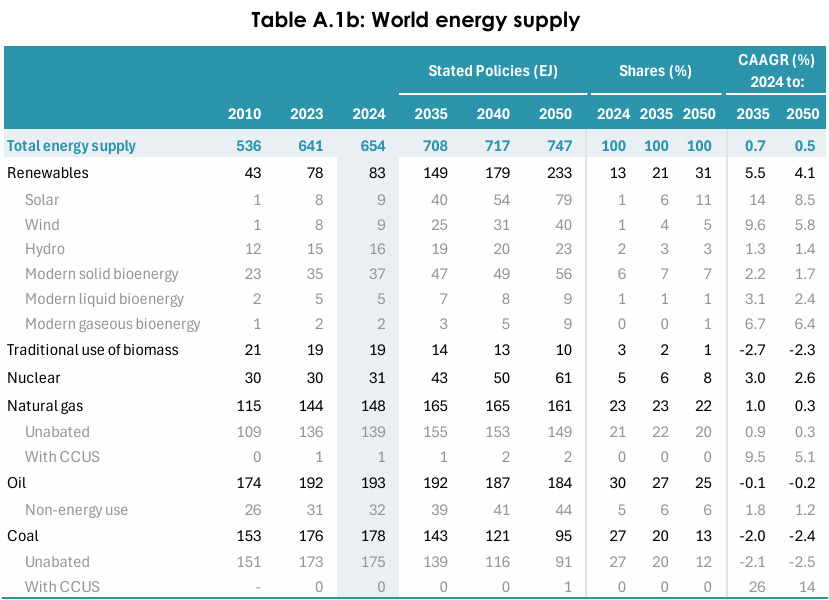
Page 420.
But let us now turn to the wife of the man who authorized the construction of the first nuclear reactor, Eleanor Roosevelt, who I personally regard as the greatest Democrat to ever have lived, the woman who bridged great wealth and privilege with compassion for the powerless, the weak, the sick, the impoverished.
I have modified by personal settings at DU, my ignore list, designed to avoid listening some of the disturbing ignorance that characterizes the antinuke set with their dogmatic chants, which are easily shown to be not even remotely connected to reality. I have done so to react to the projection of their grotesque and toxic ignorance – which I hold to be responsible for the extreme temperatures that prevent me from safely leaving my home today for a long period – on to Ms. Roosevelt.
As far as nuclear issues go, there is no evidence that Ms. Roosevelt, who lived until 1962, until her dying day working for justice had any opinion on nuclear power although she clearly and unambiguously had strong opinions on nuclear weapons testing which widely distributed radioactive materials throughout the environment, vastly more than either the antinuke Boogeymen at Chornobyl and Fukushima, which they continuously evoke while not giving a rats ass about the roughly 105 million people who died from air pollution since the Fukushima reactors were destroyed by a natural disaster that also destroyed a city.
I happen to agree with Ms. Roosevelt's only stated position on nuclear issues, which was that nuclear weapons testing needed to be banned. My own opposition is not necessarily tied to the effect of the injection of radioactive materials into the environment, although everyone alive today since 1945 has survived despite those injections, but because they are not only destabilizing to world peace, but because they fuel the ignorance of antinukes who attach nuclear power to nuclear weapons. Note that these same people do not attach fossil fuel weapons of mass destruction, including those funded by German antinukes who funded the current fossil fuel powered war in Ukraine by buying fossil fuels to replace nuclear power from Vladmir Putin, to the fossil fuels on which so called "renewable energy" depends. Fossil fuel weapons of mass destruction have killed orders of magnitude more people than nuclear weapons of mass destruction have come close to killing, but the selective attention paid is not commensurate with this reality.
For ignorant people to project their ignorance on to Ms. Roosevelt offends me, but if she had objected to nuclear power like a modern antinuke ignoramus, that would have no bearing on whether air pollution killed vastly more people than either the nuclear engineering failure at Chornobyl or the natural disaster driven failure of the reactors at Fukushima combined.
The number of people killed by radiation exposure at Fukushima is about 19,000 people less than the 19,000 people killed by seawater in the Sendai Earthquake responsible for the reactor failure, but we don’t see antinukes calling for the banning of coastal cities.
I of course, cannot speak for Ms. Roosevelt, but one is struck, when one visits the museum and library at the Franklin Delano Roosevelt National Historical Site, and tours the Springwood house she shared with her husband during their “armed truce” of a marriage, or visits her post Presidency small home at Valkill, one cannot come away unimpressed by the couple’s obvious intelligence, breadth of education, some of which was clearly autodidactic and informal, and their humanity, if only from looking at the size of their book collections, never mind the displays detailing their actions during some of the greatest tragedies in human history.
Ms. Roosevelt was not an omniscient goddess, nor did she ever claim to be. She had flaws and weaknesses, as do all human beings, but the deliberate and overt embrace of ignorance was not among them. I do not know that she was heavily involved in science, if she ever met Enrico Fermi, or Albert Einstein, or Robert Oppenheimer, or for that matter, James Conant or Arthur Compton. Perhaps she did, maybe she didn’t. I would not hazard a guess on what she thought of these great men.
One thing I surmise, her greatness grew out of her weaknesses, her youthful lack of confidence, the contempt her mother felt for her, her father’s alcoholism that led to his early death, her husband’s marital affairs, her overbearing mother-in-law, but for all these things, I’m quite sure that if nothing else, she could feel compassion for the people killed by appeals to ignorance. And let’s be clear, antinuke ignorance kills people because nuclear energy saves lives.
I do not speak for her, nor would I ever claim to do so, but I am quite sure, given her profound humanity and her clearly high intelligence and outstanding ethics, she, at least, could look at facts and draw sensible conclusions, even if, sixty-four years after her death we have people unjustly trying to project their own deadly ignorance on to her.
My evocation of Ms. Roosevelt had zero to do with her knowledge of science or her opinions on engineering. It was merely to indicate my admiration of her famous statement that one should not be constrained from taking an action because one believes that action is difficult, even if one thinks impossible, particularly when the life of the world is at stake. I have not said that building thousands of nuclear reactors would be easy, cheap, or without difficulty. Like the collapse of the planetary atmosphere itself, even greater than the Second World War, it is to my mind the most profound challenge humanity has faced since walking out of Africa. What I have said is that if we are to save the world, the building of thousands of nuclear reactors must be done, irrespective of the nonsense put forth by intellectual and morally Lilliputian antinukes. I am unafraid to embrace that firm reality.
As this grotesque misinterpretation of the great Ms. Roosevelt’s statement I have evoked horrifies me, along with the projection of one’s own ignorance on to her. As such I felt compelled to respond.
Speaking of constraints, I personally unconstrained in stating that anyone claiming that we do not need nuclear reactors because we can tear the shit out of every square centimeter of the Earth’s surface for industrial plants for solar and wind garbage that will be landfill before today’s toddlers can graduate college is, at least in my opinion, uneducated, unwise, and oblivious to reality, one such reality being the weather outside as I write, plants, animals withering under extreme heat; the damage it is causing being irretrievable. One must be both morally and intellectually blind to not notice what is happening right outside my front door and billions of other front doors as I write:
The world is burning up. One would need to be a complete fool to not see this.
Have a nice holiday.