Environment & Energy
Related: About this forum
A Rather Compelling Scientific Rumination on Wind Energy and Sustainability: Blade Waste.
The following paper appeared in a recent issue of a scientific journal I read regularly:
The Wind Energy Industry Faces Significant Sustainability Challenges, Haonan Wen, Hao Yu, Xuezhi Yang, Qian Liu, and Guibin Jiang Environmental Science & Technology 2026 60 (6), 4466-4469.
The paper isn't peer reviewed (not that it needs to be), but is called a "Scientific Opinion," a regular feature of this journal. (The belief among the public that if a paper is peer reviewed it is oracular and above criticism is nonsense, by the way.)
The paper is, regrettably, behind a firewall for the public, but as I have access, I'll excerpt it with some comments.
I recently highlighted, with a picture of its massive scale in this space an illegal wind turbine blade dump in Texas:
Four indicted in Sweetwater wind turbine blade dumping probe; cleanup not yet started
There is no word describing what a "clean up" were one to "start" would involve, but perhaps the paper, excerpted below, will give some insight
From the paper's introduction:
WTBs are primarily composite structures, comprising a box beam (spar cap and shear web) and an aerodynamic shell. The spar caps are solid fiber-reinforced polymer (FRP) laminates, whereas the shear webs and shell are typically FRP–core–FRP sandwich forms with polymer foam or balsa cores. Manufacturing these components still relies on catalysts, curing agents, flame retardants, and plasticizers. While functionally irreplaceable, these substances lock in pollutant risks that inevitably resurface during end-of-life treatments. In the absence of blade-specific regulation, such chemicals remain in service, particularly in older equipment containing phased-out compounds. This legacy of embedded chemicals complicates end-of-life management and amplifies disposal risks. Prior work shows that additives in FRP waste, including WTBs, can persist through recycling processes and pose long-term environmental hazards, (3) yet most assessments of WTB treatment options have not put these chemicals, and the secondary pollutants they can generate, at the center of the evaluation. (4) Instead, existing comparisons are typically framed around recovery yield, cost, or energy–climate metrics under tools like life cycle assessment (LCA) or technology readiness levels (TRLs). (5) Here we bring secondary pollution back into focus by summarizing the major pollutant classes associated with blade materials and linking them to the treatment routes where releases are most likely (Figure 1a). Current treatment strategies include landfilling, incineration, mechanical recycling, thermal recycling, and chemical recycling (Figure 1b). (6) Each pathway can generate hazardous pollutants if controls are inadequate, posing risks to both human health and ecosystems (Table 1). (4)...
I'll produce table 1 below, but a comment is in order about whether wind energy is, in fact, a "cornerstone" of global power. The author reports that in 2024, the wind industry had 1136 GW of capacity. I personally object strongly to the use of the unit of power, the Watt instead of using the unit of energy, the Joule. The use of the former unit ignores the issue of time, specifically known as the capacity factor, which is the percentage of time that the capacity is producing energy and how much energy it is producing compared to its rated power if it operated at full power 100% of the time, something wind turbines obviously can't do. In a comment in one of my posts, A Commentary on Failure, Delusion and Faith: Danish Data on Big Wind Turbines and Their Lifetimes, I gave the capacity factor for all the wind turbines in Denmark:
It doesn't take too much spreadsheet work to estimate an answer to your question.
If these were reliable plants - plants that operated at 100% capacity utilization - the theoretical energy output would have been 0.197 Exajoules. As they are unreliable junk, their actual output was 0.0579 Exajoules, meaning their capacity utilization for all of 2020 was 29.35%.
If, depending on the weather in local areas, this capacity factor is representative, 1136 GW of capacity, reported in the paper, would works out to 10.5 Exajoules of energy, which is close to the figure reported based on more detailed analysis based on actual output by the IEA in the 2025 World Energy Outlook, which is 9 Exajoules, this on planet where human energy consumption was 654 Exajoules in 2024.
In my opinion the IEA is an appalling low figure for a trillion dollar industry, as is my back of the envelop calculation. It is, in fact, a vast waste of money, land and resources.
Let me return to the paper.
Before sharing table 1, let me offer a figure from the text, the caption of which defines the toxins found in wind turbine blades being dumped all around the world in landfills. It covers the various means of getting rid of some of these 43 million tons that have accumulated or are predicted, by soothsaying, to accumulate "by 2050." (The "by XXXX" where XXXX is some year in the future, where in all probability the person doing the soothsaying about a so called "renewable energy" nirvana will be dead, is a common feature of discussions of the Godotian future of this stuff.)
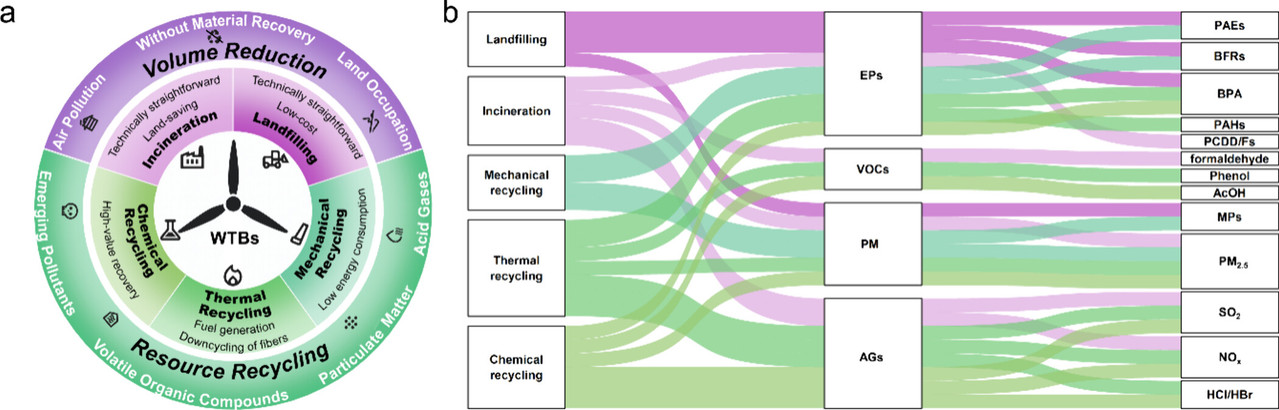
The caption:
I'm not sure how quantitative the Sankey flow diagram is, but it's illustrative in any case.
Table 1, using the abbreviations from the caption above and it's caption:
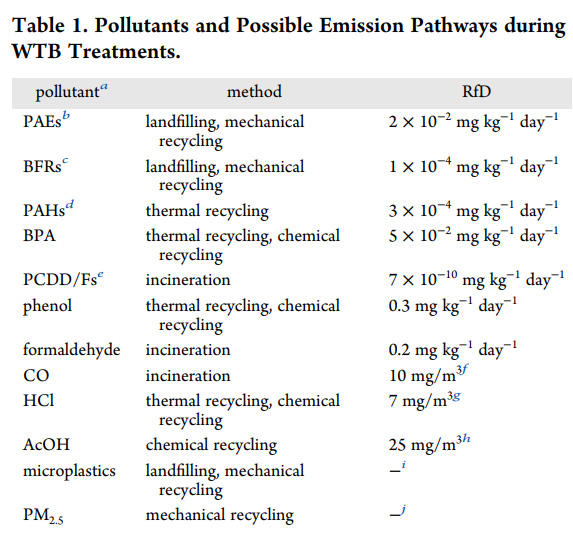
Table 1's caption:
b The RfD for PAEs is represented by di(2-ethylhexyl) phthalate (DEHP), which is a prevalent phthalate in PVC foams and is extensively studied in risk assessment.
c The RfD for BFRs is represented by 2,2′,4,4′-tetrabromodiphenyl ether (BDE-47), which is widely used as a representative congener in risk assessment.
d The RfD for PAHs is represented by benzo[a]pyrene (BaP), which is the most commonly used index compound in risk assessment.
e The RfD for PCDD/Fs is represented by 2,3,7,8-tetrachlorodibenzo-p-dioxin (2,3,7,8-TCDD), which is the most commonly used reference compound in risk assessment.
f The reference value for carbon monoxide (CO) is derived from the U.S. EPA’s National Ambient Air Quality Standards (NAAQS) for an 8 h average exposure.
g The reference value for hydrogen chloride (HCl) corresponds to the Occupational Safety and Health Administration (OSHA) permissible exposure limit-ceiling (PEL-C).
h The reference value for acetic acid corresponds to the PEL for an 8 h time-weighted average (TWA) exposure, as defined by OSHA.
i No official RfD has been established for microplastics; current references are based on advisories from the World Health Organization (WHO) and the European Chemicals Agency (ECHA).
j No official RfD has been established for PM2.5; current references are based on WHO Air Quality Guidelines and NAAQS.
The "RfD," the reference dose, is defined in toxicology as the highest "safe" dose on a chemotoxin a human can stand without incurring physiological damage, generally, but not always, with reference to carcinogenicity.
Not to be too scary, PCDDs are the class of compounds which includes the defoliant used in Vietnam during the US Imperial war there, "Agent Orange."
Let's be clear on something, OK?
The wind industry has nothing, zero, zip, nada, to do with addressing the ongoing collapse of the planetary atmosphere. The main purpose of this industry is to attack the only real option to slowing and eventually stopping the collapse, nuclear energy. If you listen to the claptrap coming out of defenders of this useless exercise in industrializing wilderness to service shit like cars, people making nonsense statements like, "there is no safe level of radioactivity" even though potassium, an essential element makes all living people radioactive, they just don't give a rat's ass about how many people die because of fossil fuels. When they whine about the collapse of the atmosphere, it's all crocodile tears, in particular because they are attacking the best means of addressing this crisis that is here and now. They are only interested in attacking nuclear energy.
There is, therefore, no moral or intellectual or scientific or environmental reason to support wind energy. That we are throwing trillions of dollars at this junk, paving access roads through wilderness, building fast toxicologically nightmare dumps, for no good reason cannot be defended. The attack on nuclear energy through this, and every other avenue, is, in my view, a crime against all future generations.
The authors' concluding remarks:
As stated above, my opinion, in conflict with the author's remarks, is that there is no benefit associated with this junk.
Have a nice weekend.