Welcome to DU!
The truly grassroots left-of-center political community where regular people, not algorithms, drive the discussions and set the standards.
Join the community:
Create a free account
Support DU (and get rid of ads!):
Become a Star Member
Latest Breaking News
Editorials & Other Articles
General Discussion
The DU Lounge
All Forums
Issue Forums
Culture Forums
Alliance Forums
Region Forums
Support Forums
Help & Search
General Discussion
Related: Editorials & Other Articles, Issue Forums, Alliance Forums, Region Forums'You can't make billions without hurting people': Cory Doctorow on Elon Musk, the AI bubble and bosses cruel fantasies
https://www.theguardian.com/technology/2026/jun/24/cory-doctorow-on-elon-musk-ai-bubble-bosses-cruel-fantasies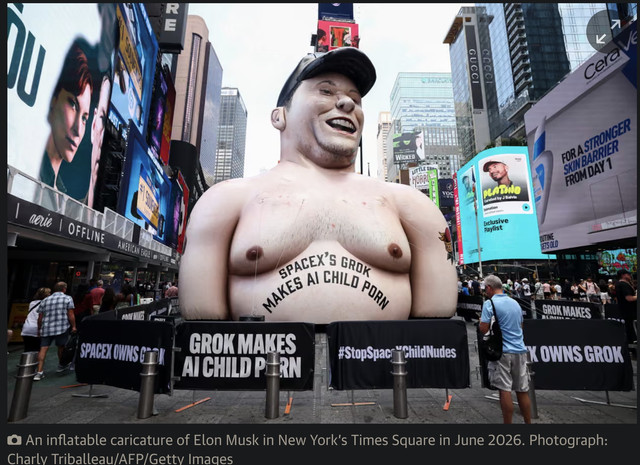
A “centaur”, in automation theory, is a person assisted by a machine, and a “reverse centaur”, hero of Cory Doctorow’s new book, The Reverse Centaur’s Guide to Life After AI, is a “human who is conscripted into acting as an assistant to a machine”. Every warehouse worker who ever had to urinate in a water bottle because they couldn’t otherwise meet the fulfilment targets set by an algorithm is a reverse centaur. Reaching into the future, everyone who has to sit in a self-driving truck to make sure it doesn’t crash, presumably on minimum rather than truck-driver wages, is a reverse centaur; as is every lawyer no longer on lawyer’s money checking Gemini’s command of precedent, every indie band scraping a living doing covers of AI-generated hits, and so on. That, anyway, is the promise: AI is coming for your job, and it is coming for your kids’ jobs, and there is no point fighting it because the future’s already here.
Wiping out the world of work, and with it our ability to sustain ourselves and live autonomous lives, is only the beginning, if you listen to AI’s architects. Elon Musk has called it the single greatest threat to human civilisation, Sam Altman has said it will “most likely lead to the end of the world” and Dario Amodei, CEO of Anthropic, memorably forecast that AI would come to see us the way we see animals: cute to have around but ultimately a resource to be exploited. “AI people claim they’re about to create God, by teaching words to a word-guessing programme,” Doctorow says. “It’s grandiose.”
snip
AI cannot and will never render us obsolete, Doctorow says. “It’s a conjuring trick. That’s probably the most important thing to get across.” A machine has been invented that is really good at building sentences by predicting what word would usually come next, and we invest it with meaning, insight, omnipotence. But we’re “imputing intentionality to this thing that intends nothing. It’s not because, objectively, it seems intentional, but because, in a state of nature, we don’t encounter sentences that don’t have sentence writers, we don’t encounter images that don’t have painters, and so on.” We marvel when it does things right, and conveniently ignore what it gets wrong, or indulge its “hallucinations”, which is just a fancy word for “errors”.
“Where I think the word ‘hallucination’ is useful,” he says, “is not to describe what the AI is doing, but what we do when we encounter a word salad, and we impute a writer to the word salad.” If you think AI can become conscious, he suggests, it’s because you’ve forgotten what consciousness is.
Wiping out the world of work, and with it our ability to sustain ourselves and live autonomous lives, is only the beginning, if you listen to AI’s architects. Elon Musk has called it the single greatest threat to human civilisation, Sam Altman has said it will “most likely lead to the end of the world” and Dario Amodei, CEO of Anthropic, memorably forecast that AI would come to see us the way we see animals: cute to have around but ultimately a resource to be exploited. “AI people claim they’re about to create God, by teaching words to a word-guessing programme,” Doctorow says. “It’s grandiose.”
snip
AI cannot and will never render us obsolete, Doctorow says. “It’s a conjuring trick. That’s probably the most important thing to get across.” A machine has been invented that is really good at building sentences by predicting what word would usually come next, and we invest it with meaning, insight, omnipotence. But we’re “imputing intentionality to this thing that intends nothing. It’s not because, objectively, it seems intentional, but because, in a state of nature, we don’t encounter sentences that don’t have sentence writers, we don’t encounter images that don’t have painters, and so on.” We marvel when it does things right, and conveniently ignore what it gets wrong, or indulge its “hallucinations”, which is just a fancy word for “errors”.
“Where I think the word ‘hallucination’ is useful,” he says, “is not to describe what the AI is doing, but what we do when we encounter a word salad, and we impute a writer to the word salad.” If you think AI can become conscious, he suggests, it’s because you’ve forgotten what consciousness is.
Lots more from the remarkable Cory at the link.
And it all comes for (ALMOST) free!!!

2 replies
 = new reply since forum marked as read
Highlight:
NoneDon't highlight anything
5 newestHighlight 5 most recent replies
= new reply since forum marked as read
Highlight:
NoneDon't highlight anything
5 newestHighlight 5 most recent replies
= new reply since forum marked as read
Highlight:
NoneDon't highlight anything
5 newestHighlight 5 most recent replies
'You can't make billions without hurting people': Cory Doctorow on Elon Musk, the AI bubble and bosses cruel fantasies (Original Post)
usonian
18 hrs ago
OP

Redleg
(7,066 posts)1. The Tavistock studies seem quite relevant now
I kind of wish I had kept up with my early research of the impacts of technology on the social-psychological aspects of the workplace. No, instead I had to chase a more glamorous topic, creativity at work and in work-teams.

usonian
(27,414 posts)2. The internet was designed to be open and point-to-point
The "network effect" concentrated ir in a few places (shades of mainframe computing) and since the only money model that worked was advertising (low hanging fruit from print and TV media) it became a "quantity (clicks) over quality" world.
And post-truth at that.
Some of us still see it as liberative, not that many, unfortunately.
Those who can't control themselves, try to control others.